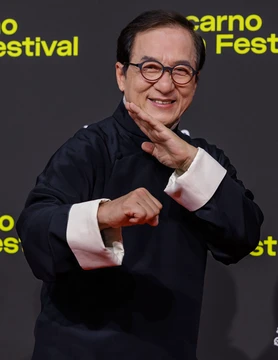
Jackie Chan Stunt Team
No wires, no doubles, no mercy—just sweat, bone, and a perfectly timed pratfall.
Jackie Chan's Stunt Team is the long-standing collective of martial artists, stunt performers, and choreographers who have collaborated with Jackie Chan across more than five decades of action filmmaking. Rather than a single formal organization with a charter, it is better understood as a tight-knit family of practitioners bound by a shared philosophy: the performer executes the stunt, the body tells the story, and the camera captures the truth of the fall. This group has been the engine behind the distinctive, grounded, acrobatic action that defines Chan's films—from the bamboo-forest brawls of the 1970s to the urban spectacle of Police Story and the globe-trotting set pieces of Rush Hour. Their work stands in deliberate contrast to the wire-heavy, slow-motion aesthetic that later dominated Hong Kong action cinema, favoring sweat, impact, and comedic timing over spectacle for its own sake.
- Affiliation
- Jackie Chan / independent collaboration network
- Active since
- 1970s
- Core philosophy
- Performer-executed practical stunts; minimal reliance on wires or digital replacement
- Notable members
- Sammo Hung (Hung Siu-tung), Yuen Biao, Yuen Wah, and rotating stunt performers
- Signature style
- Acrobatic, comedic, physically grounded action choreography
- Key films contributed to
- Drunken Master, Police Story, Project A, Rush Hour, The Karate Kid, and numerous others
- Status
- Ongoing; members continue to collaborate into the 2020s
Lore & Background
The roots of the team stretch back to the Yuen Wu Academy and the broader Hong Kong martial-arts community of the 1960s and 70s, where Jackie Chan trained under Yuen Hu and Yuen Biao alongside Sammo Hung and other future stars. What began as a training cohort and a group of friends who moonlighted as stunt performers for other productions gradually coalesced into a working unit whenever Chan was attached to a project. There was no single 'founding meeting'; the team simply accumulated, person by person, film by film, over years of shared bruises and shared meals. The team's identity is defined as much by what it refuses to do as by what it does. In an industry increasingly tempted by wire rigs, digital compositing, and hidden safety rigs, Chan and his collaborators have consistently chosen the harder path: a real jump off a real building, a real fight in a real kitchen, a real crash into a real wall. This commitment to physical truth gives the action a weight and a comedy that CGI cannot replicate—the audience can see the flinch, the wince, the genuine fear in the eyes, and that vulnerability is what makes the stunts land. Sammo Hung, in particular, has served as both martial-arts instructor, co-star, and informal 'captain' of the practical-stunt philosophy. The Yuen family members have provided the deep kung-fu lineage and choreographic vocabulary. Together they form a living archive of physical comedy and martial-arts storytelling that has no true parallel in global cinema.
In Their Own Story
The morning light hits the wet concrete of a Hong Kong back-alley set. A stunt performer stretches his hamstrings against a parked van while Sammo Hung argues—gently, with a half-smile—about the angle of the next throw. Jackie Chan, still in his rumpled street clothes, walks the length of the alley twice, counting his steps, testing the friction on his shoes. No one says 'action.' No one calls for a safety net. Someone hands Chan a bottle of water. He cracks it open, takes a swig, and nods. The camera rolls. The first punch connects with a wet, meaty crack that echoes off the brick. The second throw sends a stuntman cartwheeling into a stack of crates that splinter exactly as choreographed. Chan lands on his back, breathes, and grins up at the lens. The whole thing took eleven seconds. They did it fourteen times before lunch.
Reader's Guide
The Jackie Chan Stunt Team is less a single entity than a constellation of collaborators who have orbiting the actor since the mid-1970s. Its core has always been the Yuen family martial-arts lineage—Yuen Biao, Yuen Wah, and their students—combined with the comedic-fighting sensibility of Sammo Hung and the broader pool of stunt performers who trusted Chan to let them hit the ground for real. Their contributions span the entire filmography. In Drunken Master (1978), the team's acrobatic choreography turned a bamboo forest into a playground. In Police Story (1985), their willingness to perform a 20-foot elevator-shaft fall without a wire became one of the most iconic set pieces in action cinema. In Project A (1987), they turned a crumbling building into a Rube Goldberg machine of practical destruction. In the Rush Hour films, they adapted their style for a Hollywood audience while retaining the 'real hit, real fall' principle. Notable members beyond Chan himself include Sammo Hung, who has served as instructor, co-star, and de facto philosophy-keeper; the Yuen brothers, who provide the kung-fu grammar; and a rotating roster of stunt performers whose names often go uncredited but whose bodies bear the scars of the work. Their impact on action cinema is profound. By proving that a stunt can be both spectacular and genuinely dangerous, they set a benchmark that later filmmakers—whether emulating or reacting against—must acknowledge. The 'Jackie Chan stunt' remains a shorthand in the industry for action that prioritizes the performer's body over the technology.
Did You Know?
- Jackie Chan has publicly stated that he prefers to perform his own stunts and that his team's job is to make those stunts as safe as possible while keeping them as real as possible—a philosophy that has led to numerous i
- Sammo Hung and Jackie Chan have been friends and training partners since their youth in the Yuen Wu Academy, and their on-screen chemistry in films like Project A and Drunken Master II is built on decades of off-screen f
- The team's approach to action—grounded, comedic, physically punishing—directly influenced the 'practical effects' movement in later action filmmaking and is often cited as a counterpoint to the wire-fu style associated w
- Many of the stunt performers in the team have worked with Chan across multiple decades, meaning some individuals have been part of the collaboration longer than the span of most actors' entire careers.
More in Stunt Teams & Crew
Elsewhere in the Jackie Chan universe
Spotted an error? Know more?
This is a living reference — every entry is fact-audited, and reader corrections feed straight into our audit queue. Suggest an edit · See this site's audit record