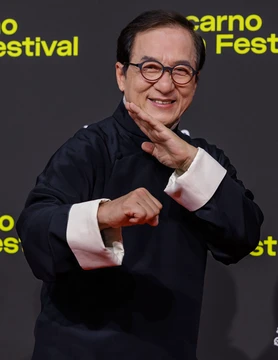
Jackie Chan
One man, a hundred broken chairs, and a crew that refuses to let him die on camera.
Jackie Chan is the beating heart of an action-cinema universe built on one radical principle: the star does his own stunts, and a dedicated crew of trusted performers, coordinators, and builders exists to keep him alive while he does it. Rather than relying on doubles, wire work, or digital effects, Chan's films are constructed around a collaborative stunt team that rehearses elaborate, often absurdly dangerous sequences until they can be executed in a single, unbroken take. This entry treats Chan not merely as a character on screen but as the architect of a working system — a family of stuntmen, fight choreographers, set designers, and safety engineers whose collective craft has defined a recognizable style of physical comedy and kinetic action that has shaped global filmmaking for over five decades.
- Role
- Actor, Stunt Performer, Director, Producer, Choreographer
- Affiliation
- Hong Kong cinema / Hollywood
- First appears
- 1960s (child actor in Hong Kong productions)
- Status
- Active (filming and directing into the 2020s)
- Signature style
- Practical stunts, environmental fight choreography, physical comedy
- Training background
- Peking Opera and martial arts (China Drama Academy)
Lore & Background
Chan's approach to action is inseparable from his training. Years of Peking Opera discipline — the precise footwork, the controlled falls, the rhythmic timing of a choreographed sequence — gave him a body that could be trusted to land a roll, catch a falling beam, or tumble down a flight of stairs without breaking. That foundation let him build a philosophy: every object in the set is a weapon, a shield, or a springboard. A dining table flips. A fire hose becomes a lasso. A motorcycle becomes a trampoline. The stunt team's job is to make those moments look effortless while being, in rehearsal, terrifyingly real. The crew surrounding Chan has always been small, familial, and deeply loyal. Unlike the large, hierarchical stunt departments of Western productions, his teams have historically operated like a troupe — the same faces showing up from film to film, learning each other's rhythms, anticipating a throw before it happens. This intimacy means the comedy lands: the audience trusts that the person flinging a refrigerator across a room is the same person who will catch it, grimace, and deliver a perfectly timed one-liner. Over the decades, that model has influenced generations of action filmmakers. Directors who grew up watching Chan's Hong Kong pictures in the 1980s and 1990s went on to build their own stunt departments around the same principles: practical, rehearsed, human. The legacy is less a single signature move and more a culture of trust between a performer and the people who build the world around him.
In Their Own Story
The set was a narrow alley in a Hong Kong backlot, and the plan was simple in theory: Jackie would vault a chain-link fence, slide under a low beam, and come up the other side with a stolen briefcase. In practice, the beam was slightly too low, the fence was slightly too wide, and the briefcase handle kept catching on his jacket. Take after take, the same three people — a stunt double holding the beam steady, a grip adjusting the fence, and Chan himself, grinning through a bruised shin — reset the sequence. On the fourteenth take, he hit the beam, slid, caught the fence with one hand, and the briefcase finally flew free. The crew exhaled. Someone off-camera said, "Same time tomorrow?" And everyone laughed, because they all knew the answer was yes.
Reader's Guide
Jackie Chan's stunt operation has evolved from a small circle of Peking Opera classmates into a professional crew that has worked across dozens of productions in Hong Kong, the United States, and beyond. The core philosophy has never changed: the star performs the stunt, the crew engineers the safety, and the comedy emerges from the gap between danger and control. Sammo Hung, a fellow graduate of the China Drama Academy, is perhaps the most recognizable long-time collaborator. He has served as stuntman, co-star, and director across numerous Chan productions, embodying the "partner in the frame" role that defines the style. Other trusted coordinators and second-unit stunt performers have cycled through the team over the decades, but the working method — exhaustive rehearsal, practical effects, minimal reliance on wire or digital replacement — has remained constant. The crew's contributions extend beyond any single film. Their choreography of everyday objects, their willingness to build a set piece around a single continuous camera shot, and their emphasis on the performer's physical reaction over the spectacle of the fall have become a visual language recognized worldwide. Action directors in Hollywood, South Korea, and beyond have cited Chan's team as a model for how a small, dedicated group can produce stunts that feel genuinely dangerous without ever cutting to a double. The impact is measurable in the texture of modern action cinema: the lingering close-up on a bruise, the comedic beat after a near-fatal tumble, the sense that the person on screen is the same person who just threw a car. That texture is the fingerprint of a crew that treats every broken chair as a small, shared victory.
Did You Know?
- Chan trained in Peking Opera and Chinese martial arts from roughly age seven at the China Drama Academy in Hong Kong, a discipline that emphasized controlled falls and precise body mechanics long before he ever appeared
- A hallmark of his films is the use of mundane, set-dressing objects — chairs, tables, fire hoses, refrigerators — as integral parts of fight choreography rather than as background props, a technique his stunt team rehear
- Sammo Hung, a fellow China Drama Academy alumnus, has appeared as a stuntman, co-star, and director in a large number of Chan productions, making him one of the most persistent faces in the franchise's visual vocabulary.
- Chan's approach to stunts — performing them himself, often in a single unbroken take, and treating the physical comedy as inseparable from the action — has been cited by a generation of action filmmakers as a foundationa
More in Stunt Teams & Crew
Elsewhere in the Jackie Chan universe
Spotted an error? Know more?
This is a living reference — every entry is fact-audited, and reader corrections feed straight into our audit queue. Suggest an edit · See this site's audit record