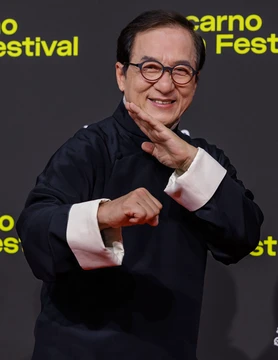
Bajiquan
When the alley gets too narrow for a flip, Bajiquan turns the body into a loaded spring.
Bajiquan (八极拳), often translated as 'Eight Extremes Fist,' is a short-range Chinese martial art built around explosive power generation, structural rooting, and devastating close-quarters striking. Within the Jackie Chan cinematic universe, it represents the grounded, brutal counterpoint to his trademark acrobatic flair—the style that kicks in when the comedy drops and the fight becomes a matter of survival in a tight alley, a crowded market, or a confined room where there is no space to jump. Rather than appearing as a single labeled 'school' in most of Chan's films, Bajiquan's principles—explosive fa jin, frame-breaking strikes, and the use of the body's eight structural points—surface organically in his choreography whenever a scene demands raw, compact violence. It is the martial-art DNA that lets him trade a flying kick for a shoulder check that sends an opponent into a wall, and it anchors the more serious, character-driven action sequences in his career.
- Style family
- Northern Chinese internal/external hybrid
- Core principle
- Fa jin (explosive power release) from a rooted, compact frame
- Range
- Close-quarters / short-range
- Signature strikes
- Shoulder strikes, elbow frames, short punches, and structural body checks
- Geographic origin
- Hebei province, northern China
- Role in Jackie Chan films
- Close-combat engine underlying his acrobatic choreography in confined-space fights
Lore & Background
Bajiquan's lineage traces to northern China, where village fighters needed a system that worked in the cramped courtyards, narrow lanes, and crowded market stalls of Hebei. Unlike the long, flowing forms of southern styles, Bajiquan compresses the fighter into a dense, coiled structure and releases energy in a single, violent burst. The 'eight extremes' refer to the eight structural points—both fists, both elbows, both shoulders, both knees, and the head—that can be driven into an opponent at point-blank range. The art rewards a fighter who can stay inside the opponent's guard and deliver one or two devastating contacts rather than trading a flurry of lighter blows. In the Jackie Chan film world, this principle shows up whenever the choreography shifts from playful, wide-arc acrobatics to something harder and more personal. A market brawl in a narrow street, a corridor fight with no room to retreat, a final confrontation where the hero is bleeding and tired—these are the moments where Bajiquan's logic takes over. The comedy drops, the music tightens, and what you see is a man using his shoulder like a battering ram, his elbow like a hammer, his hips like a piston driving a short punch through an opponent's ribs. It is the style that says: I will not dance with you; I will simply end it in one hit. Fans often note that the most emotionally charged fights in Chan's career are the ones where his character stops performing and starts fighting. That shift in tone is, in practical terms, a shift in martial-art vocabulary—from the acrobatic, external spectacle to the compact, internal violence of Bajiquan's principles. It is what makes a Jackie Chan fight feel like a story rather than just a stunt sequence.
In Their Own Story
The rain had turned the backstreet into a river of grey. Mr. Chan—tired, bruised, his jacket torn at the shoulder—backed against the brick wall of a shuttered noodle shop. Three men fanned out, grinning, confident in their numbers and their reach. He did not smile back. He dropped his weight, tucked his elbows, and let his shoulders coil like a drawn bowstring. The first man lunged with a wide, telegraphed haymaker. Chan stepped inside the arc, let the fist pass over his ear, and drove his shoulder into the man's sternum with a sound like a wet board snapping. The second man came with a knife. Chan caught the wrist, twisted, and the blade clattered into the puddle. Before the man could recover, a short, piston-like elbow drove up under his chin. The third man hesitated. That hesitation was all Chan needed. He stepped in, wrapped the man's head in both forearms, and drove his hip forward. The impact folded the man in half. Silence. Rain. The three men on the ground. Chan straightened his jacket, exhaled a long breath through his nose, and walked on into the dark.
Reader's Guide
Bajiquan originated in the villages of Hebei province, where fighters needed a system effective in tight, cluttered spaces. Its core is fa jin—a sudden, whole-body release of stored tension into a single strike—combined with a low, rooted stance that makes the fighter nearly impossible to push off balance. The 'eight extremes' (both fists, elbows, shoulders, knees) serve as the primary weapons, deployed at ranges where longer styles simply cannot reach. Jackie Chan adapted Bajiquan's principles for the screen by layering them beneath his acrobatic base. In wide-open spaces his choreography favors flips, sweeps, and environmental comedy. But the moment a scene compresses into a corridor, a kitchen, or a crowded room, the fighting language shifts: shorter steps, tighter guard, shoulder and elbow strikes replacing wide punches. The result reads as a natural escalation—the hero stops performing and starts fighting. The style is featured prominently in the close-combat sequences of films like The Karate Kid (2010), where Mr. Han's instruction emphasizes body mechanics and short-range power over flashy forms, and in the tournament and street-fight set pieces of CZ12 (2005), where Chan's character must adapt to opponents using longer-range styles. In The Foreigner (2017), the grounded, exhausted final confrontation draws heavily on Bajiquan's economy of motion. Execution on screen follows a simple pattern: coil the shoulders, drop the center of gravity, then release. A single shoulder strike, a driving elbow, a short straight punch thrown from the hip—each contact is designed to end the exchange. No combos. No flourishes. One hit, one result.
Did You Know?
- Bajiquan's name literally translates to 'Eight Extremes Fist,' referring to the eight body points—fists, elbows, shoulders, knees, and head—that serve as its primary striking weapons.
- The style's signature fa jin (explosive power) technique involves coiling the entire upper body like a spring and releasing it in a fraction of a second, which is why a single Bajiquan shoulder strike can look like the f
- In Jackie Chan's choreography, the shift from his trademark acrobatic comedy to Bajiquan-style close combat is often used as a tonal signal to the audience: the fight is now serious, and the hero is no longer performing.
- Bajiquan's emphasis on staying inside an opponent's reach makes it a natural counter to the longer-range, sweeping styles that Chan's characters frequently face in tournament and street-fight scenarios.
More in Signature Moves & Martial Arts
Elsewhere in the Jackie Chan universe
Spotted an error? Know more?
This is a living reference — every entry is fact-audited, and reader corrections feed straight into our audit queue. Suggest an edit · See this site's audit record