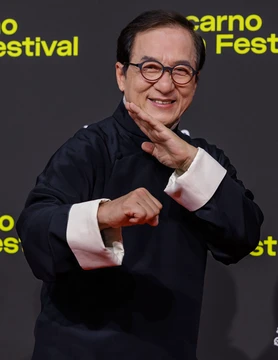
Academy Honorary Award 2016
A master of the impossible, honored at last by the industry that once looked past him.
The Honorary Academy Award presented to Jackie Chan at the 88th Academy Awards in 2016 stands as one of the most celebrated recognition moments in modern cinema. Unlike competitive Oscars, the Honorary Award is bestowed at the Academy's discretion to honor individuals whose contributions to the art of motion pictures transcend any single film. For Chan, it was a long-overdue acknowledgment of a career built on wire work, bone-jarring stunts, and a brand of physical comedy that has defined action filmmaking for over four decades. The award cemented his place in the pantheon of performers the Academy has chosen to honor beyond the usual competitive categories—joining a lineage that includes figures like Walt Disney, Alfred Hitchcock, and Audrey Hepburn. For fans and the broader film community, it marked the moment Hollywood's most prestigious body formally recognized what audiences around the world had already understood: that Chan's body is his instrument, and his craft is a form of art.
- recipient
- Jackie Chan
- award
- Honorary Academy Award
- ceremony
- 88th Academy Awards
- year
- 2016
- category
- Non-competitive Honorary Award
- recognized_for
- Lifetime contributions to physical comedy and martial arts cinema
Lore & Background
Jackie Chan's path to that stage in Los Angeles began in a Peking Opera training school in Hong Kong, where as a young boy he spent hours perfecting acrobatic flips, martial arts forms, and the discipline of the stage. That grueling childhood education—falling, bruising, rising again—became the foundation for a career in which he would routinely perform his own stunts, often in ways that left audiences gasping and fellow actors shaking their heads in disbelief. From the wire-fu spectacles of the 1980s to the brawling, comedic chaos of the Rush Hour franchise, his work carved a lane in action cinema that no one else quite occupied. For years, the Academy's recognition of Chan felt conspicuously absent. His films were global blockbusters, but the competitive Oscar categories are narrow, and a performer whose greatest skill is a backflip off a moving truck did not fit neatly into acting categories. The Honorary Award, by contrast, allowed the Academy to celebrate the totality of his contribution: the choreography, the comedy, the sheer physical risk, and the decades of mentorship he offered to younger stunt performers and directors. The 2016 ceremony became a moment of genuine emotional resonance. Chan, who had long joked about his relationship with Hollywood, accepted the honor with characteristic humility and self-deprecating humor, reminding the audience that his greatest teacher was the ground he kept falling onto during training. For fans worldwide, it validated a career that had already earned its own mythology.
In Their Own Story
The Dolby Theatre hummed with a low, electric murmur. On stage, the golden statuette sat in its velvet cradle, catching the chandelier light. Jackie Chan stepped forward in a dark suit that looked almost too formal for a man whose body had been a war zone for forty years. He paused, looked out at the sea of faces, and let a small, crooked smile spread across his weathered face. He did not need a teleprompter. He did not need a long speech. He simply held up the statuette, tilted his head as if examining a particularly stubborn wrench, and said, in that quiet, slightly breathless voice, that the best thing about this award was that he could finally put it on a shelf and not worry about it falling. The audience roared. Somewhere in the back row, a young stunt coordinator wiped her eyes and thought of every night she'd spent on the mat, waiting for him to demonstrate the next impossible move.
Reader's Guide
At the 88th Academy Awards ceremony in 2016, the Academy of Motion Picture Arts and Sciences presented Jackie Chan with a Honorary Award, recognizing his extraordinary and sustained contributions to the art of physical comedy and martial arts filmmaking. The Honorary Award is a non-competitive distinction, granted at the Board of Governors' discretion, and is reserved for individuals whose impact on cinema extends beyond any single competitive entry. The timing of the honor carried particular weight. By 2016, Chan's career spanned nearly five decades, from his early Hong Kong action-comedies of the 1970s through his international co-productions with Hollywood. Audiences in dozens of countries had grown up on his films, yet the Academy had never formally recognized him in a competitive category. The Honorary Award closed that gap, acknowledging not just his performances but his broader influence on stunt choreography, action direction, and the global reach of martial arts cinema. Chan's acceptance was brief and characteristically self-aware. He credited his teachers at the Peking Opera training school, his stunt teams, and the countless unnamed crew members who made his films possible. He joked about the physical toll of his career and the irony of being honored for work that, to him, was simply the job he had always known how to do. For the film community, the moment underscored that the Academy's highest non-competitive honor could—and should—celebrate craft, risk, and artistry in forms that resist easy categorization.
Did You Know?
- Chan trained from childhood at a Peking Opera school in Hong Kong, where the rigorous acrobatic and martial-arts curriculum became the physical vocabulary for his entire film career.
- He is widely known for performing his own stunts for the vast majority of his career, often designing and rehearsing them himself alongside his stunt teams.
- His career spans from the 1970s to the present, making him one of the longest-running active action stars in global cinema.
- The Honorary Award is distinct from the competitive Best Actor category and is granted at the Academy's discretion, meaning it can honor contributions that do not fit traditional acting criteria.
More in Legacy & Trivia
Elsewhere in the Jackie Chan universe
Spotted an error? Know more?
This is a living reference — every entry is fact-audited, and reader corrections feed straight into our audit queue. Suggest an edit · See this site's audit record